For the Land Transport Authority and bus operators of Samoa
FAST Bus
Live bus positions and arrival times for passengers, a simple app for drivers, and trip data for the LTA
False Cognitive Technologies · October 2026
False Cognitive Technologies · FAST Bus · October 2026
2
Passengers wait at the roadside without information
Passengers have no live view of where a bus is or when it will pass their village. They find out by waiting at the road.
FAST Bus adds information only
Fares and ticketing do not change
Owners keep running their own buses

Passengers
Wait at the road for an unknown time, in sun or rain, and cannot plan around a bus that is late or full.

Drivers
Have no simple way to tell people further along the road that the bus is full or has broken down.

Bus owners
The project brief says owners usually hear about breakdowns and delays by phone, after they happen.

Land Transport Authority
Has no live, regular feed of trips per route, travel times, loads, or which villages go without service.
False Cognitive Technologies · FAST Bus · October 2026
3
Each group uses its own part of one system
Passengers use a phone browser. Drivers, owners, the LTA and a platform administrator each sign in to their own area.

Passengers
Find a bus by village, see arrival times and set a leave-now alert. In Gagana Sāmoa or English, with no account.
Drivers
A phone on the dashboard linked to one bus. PIN sign-in, Start and End trip, passenger count and status buttons.

Bus owners
Manage their own buses, drivers, phones, routes and schedules. Live fleet map and trip replay.
Land Transport Authority
Live map of every participating bus, route approvals, operator directory, reports and CSV export.
False Cognitive Technologies · FAST Bus · October 2026
5
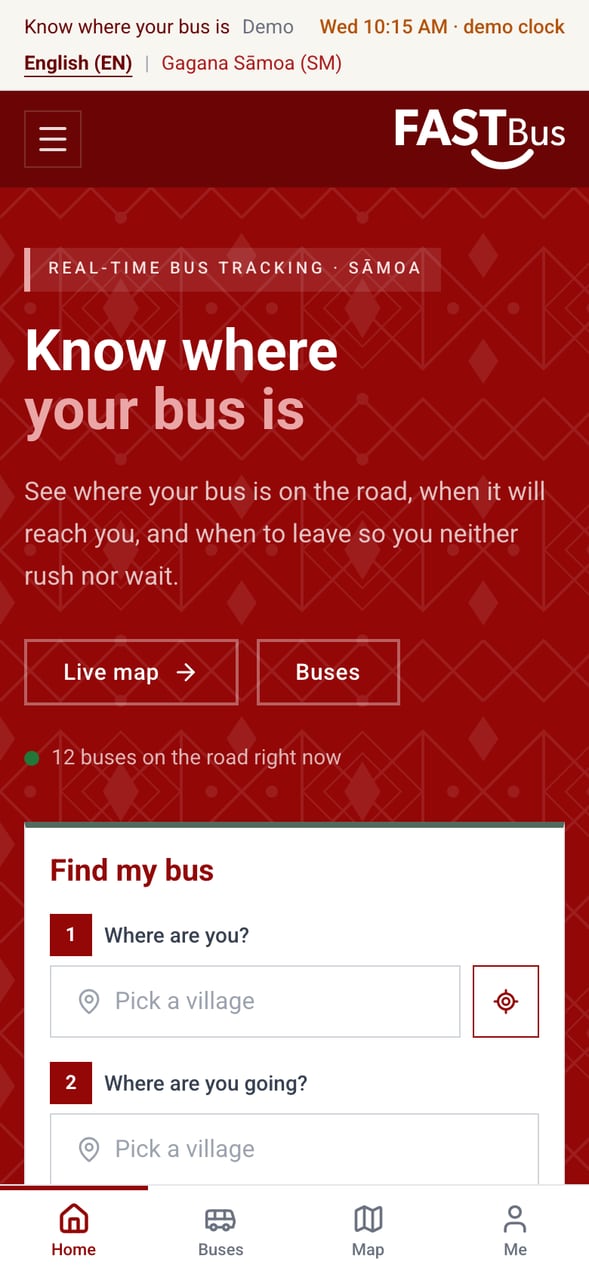
Passengers find their bus in a phone browser, no account
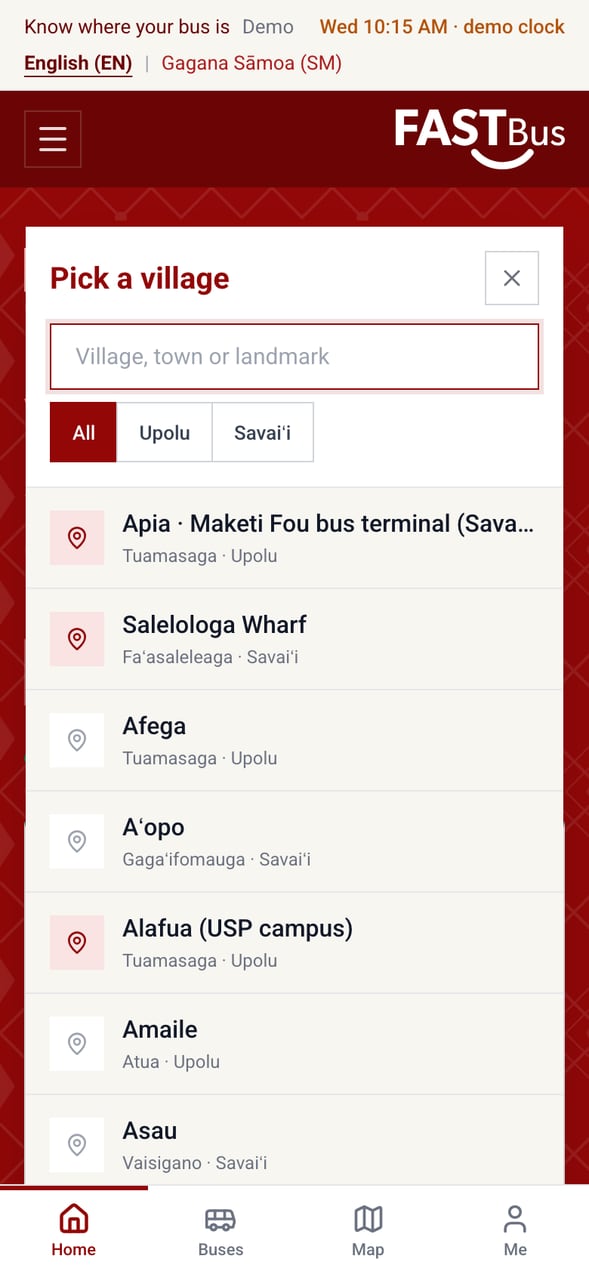
Find my bus
Pick a village or use GPS. English or Gagana Sāmoa switch at the top.
Pick a village
107 villages and landmarks on Upolu and Savaiʻi.
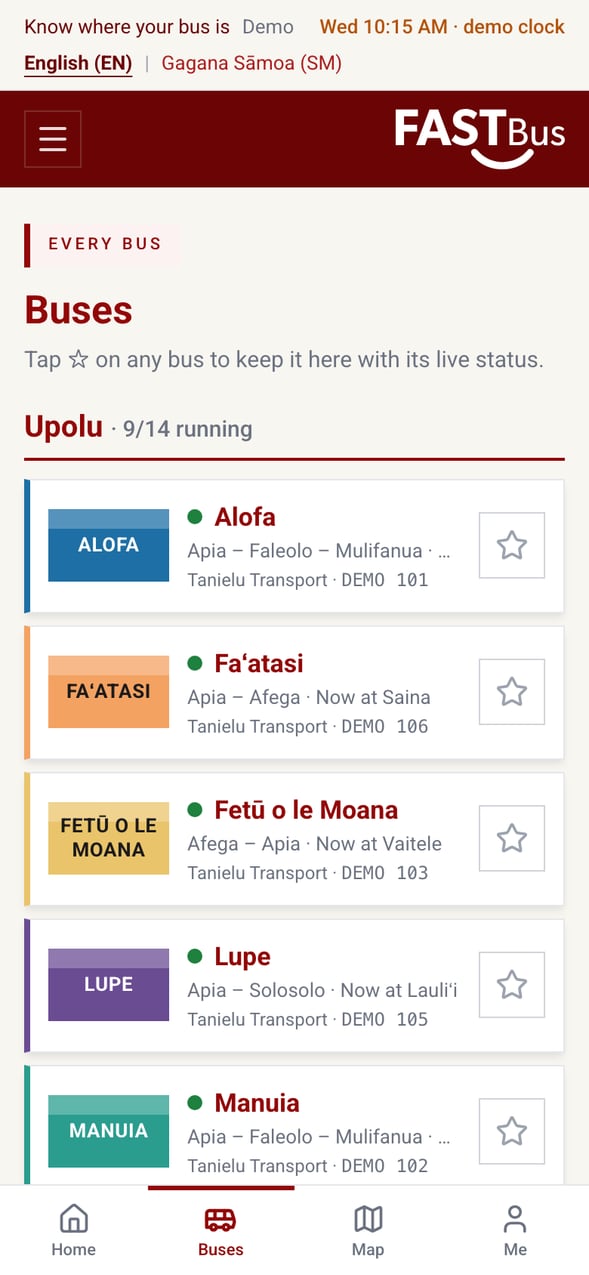
Every bus
Route, owner and current village. Sample data; figures are illustrative.
False Cognitive Technologies · FAST Bus · October 2026
6
Arrival times use the bus's position and speed on the road
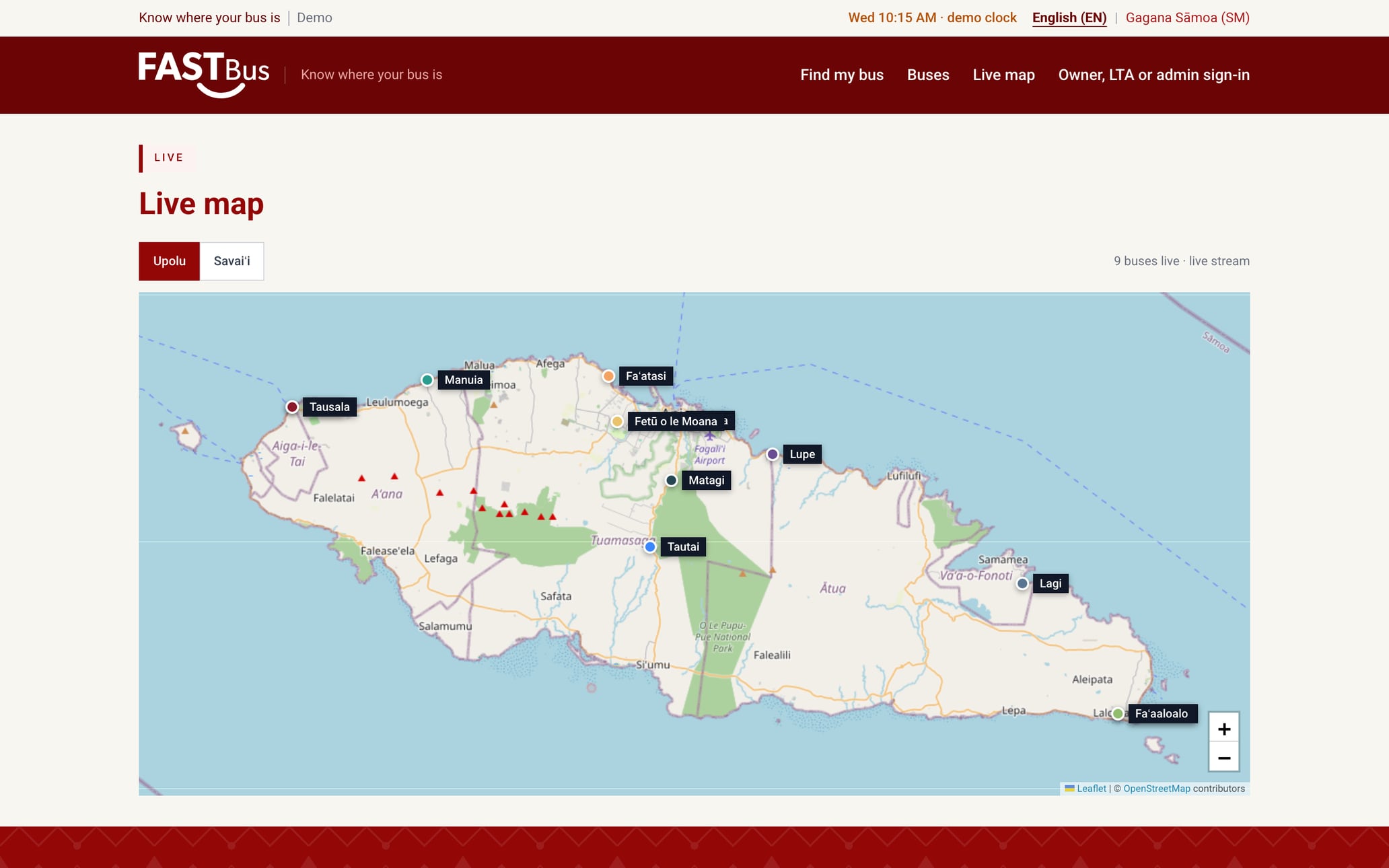
Live map
Buses on Upolu on a demonstration morning. Positions stream to the page as they arrive. Sample data; figures are illustrative.

Distance along the road
Arrival time is the road distance left divided by the bus's average speed over its last six positions.

Uncertain estimates show a range
Longer or less certain estimates show a range, such as 6 to 9 min. If the last position is over 60 s old, the range widens.

Leave-now alert
Leave time is arrival minus walk, time to get out and a safety margin. Alerts say get ready, then leave now.

Full or broken down
If the driver marks the bus full or broken down, passengers with an alert on that bus get a notice.
False Cognitive Technologies · FAST Bus · October 2026
7
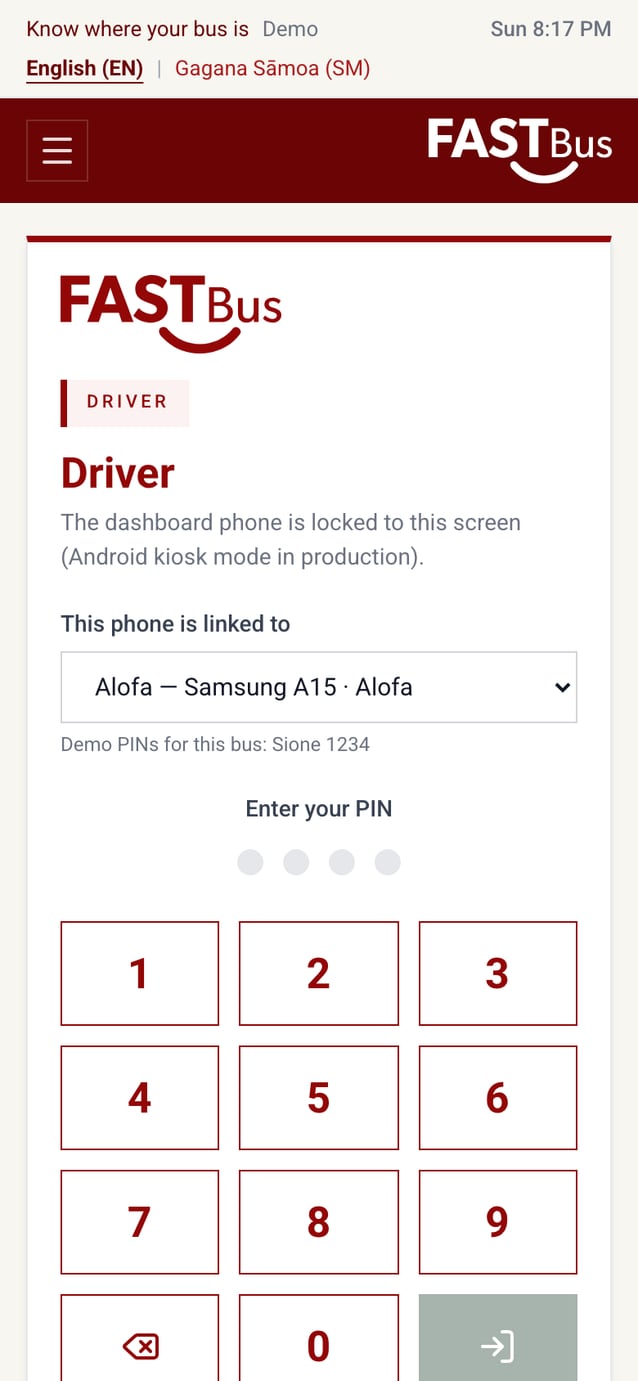
The driver app asks very little of the driver
01
Sign in with a PIN
The dashboard phone is linked to one bus. The driver enters the 4-digit PIN their owner set.
02
Pick the route and press Start
Today's scheduled routes are listed first. GPS then runs on its own and positions upload every 7 seconds.
03
Keep the passenger count
Large plus and minus buttons record how many are on board, shown against the bus's seats.
04
Flag bus full, break or breakdown
One tap each. Passengers with an alert on that bus get a notice if it is full or has broken down.
05
Press End at the last stop
Without signal, the phone keeps up to 2,000 positions and sends them later. Above 8 km/h the screen dims.
False Cognitive Technologies · FAST Bus · October 2026
9
The LTA sees every participating bus on one map
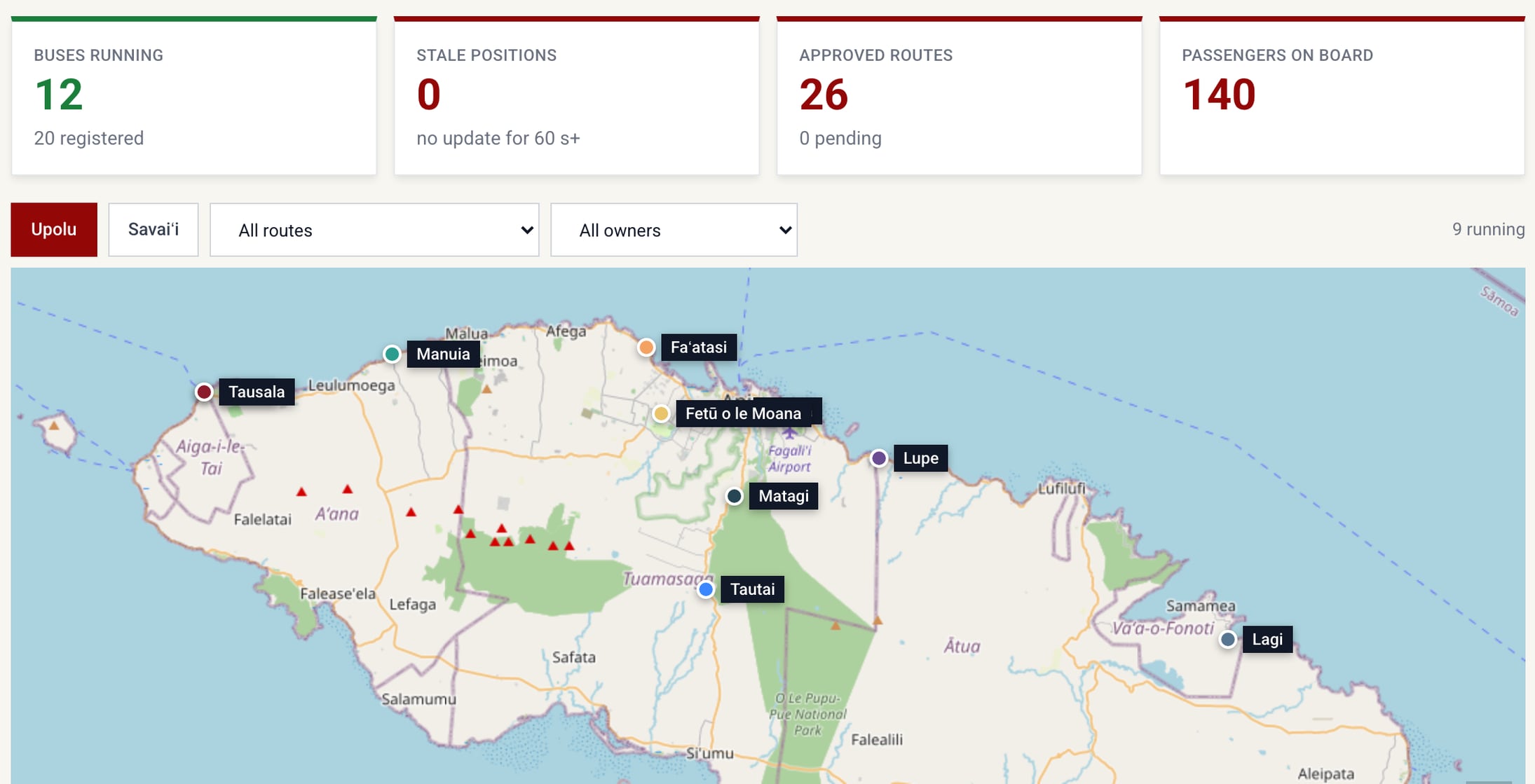
LTA dashboard
Buses running, stale positions, approved routes and passengers on board, above the live map. Sample data; figures are illustrative.

Filter the map
By island, route and owner. Only buses whose owners take part appear.
Stale positions counted
A bus with no position for 60 seconds or more is counted as stale.

Approvals and directory
Route and owner approvals, and a directory of every owner, bus, driver and phone.

Reports and CSV export
Trips, positions and villages export as CSV. Report charts follow on the next two slides.
False Cognitive Technologies · FAST Bus · October 2026
10
Passenger load shows where extra buses would help most
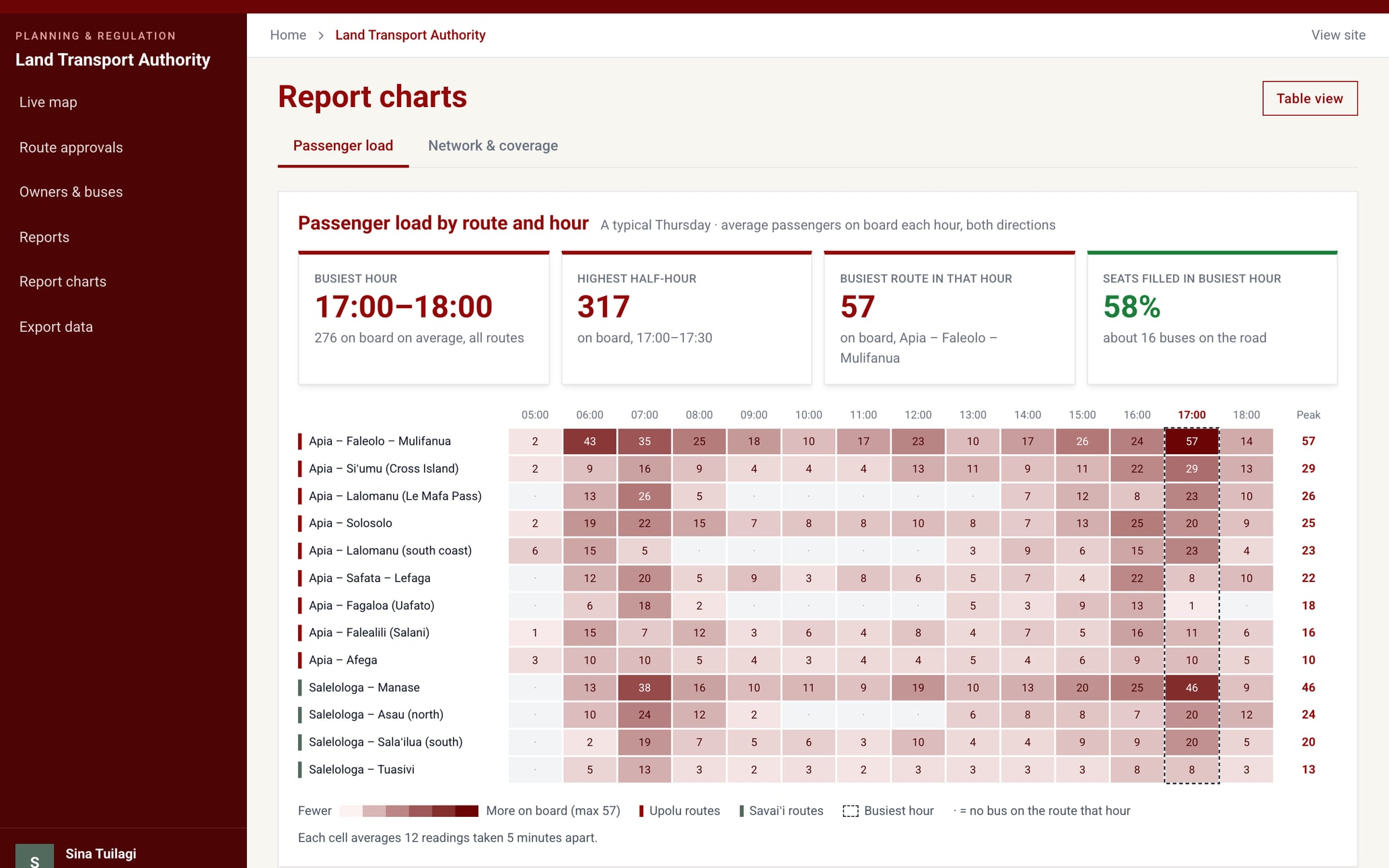
Report charts: passenger load
Average on board each route, each hour, both directions, on a sample Thursday. Sample data; figures are illustrative.

Load by route and hour
Each cell averages twelve readings taken five minutes apart. Darker cells mean more people on board.
Busiest hour
In this sample, 17:00 to 18:00, with 57 on board on Apia to Faleolo to Mulifanua.

Seats filled
58% of seats filled in the busiest hour, from the passenger counts and each bus's seats.
What it helps decide
Where an extra bus at peak would carry the most people, and which hours run nearly empty.
False Cognitive Technologies · FAST Bus · October 2026
11
Coverage reports show which villages no route reaches
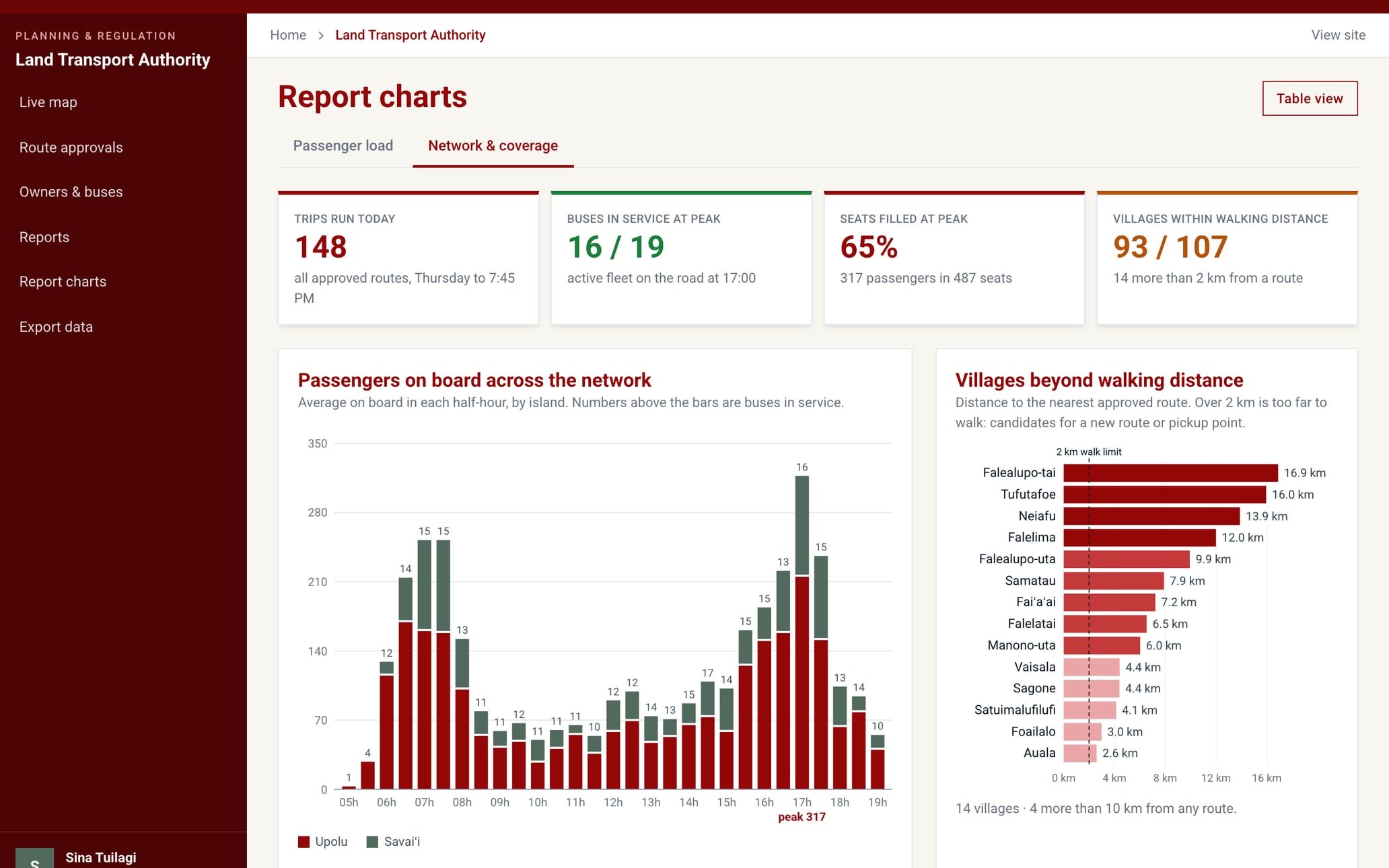
Report charts: network and coverage
Passengers on board by island every half-hour, and villages more than 2 km from an approved route. Sample data; figures are illustrative.

Load across the network
Average on board each half-hour on Upolu and Savaiʻi. Numbers above the bars are buses in service.

Villages beyond walking distance
In this sample, 14 of 107 villages are more than 2 km from any approved route.

Trips per route per day
Trips run on each approved route each day over the last 7 days, to compare with the services planned.

Travel times between villages
Planned times show today. Measured times appear once real driver trips are recorded.
False Cognitive Technologies · FAST Bus · October 2026
12
The system holds almost nothing about passengers

No passenger accounts
A search sends the passenger's location or chosen village to the server to find buses. It is not stored. Saved places stay on the phone.
Alerts hold no identity
An alert stores the browser's push address, language, bus, pickup point and timing. No name or phone number.

Access by role and audit log
Owners see only their own fleet. Sign-ins expire after 12 hours. Approvals, edits, trip starts and exports are logged.

Who owns the data
We propose that trip data belongs to each operator and is shared with the LTA. The LTA can export trips and positions as CSV.

Where data lives
The public demo holds only fictitious data. Plan: hosting in Australia or New Zealand, positions archived after 12 months.

Outside services used
OpenStreetMap map tiles, a public OSRM server for route drawing, and the browser maker's push service (such as Google or Apple).